In trying to explain how dangerous heat stroke is, it is necessary to consider the circumstances. In a risk assessment you have to ask :
- How likely is it that it will happen?
- How quickly can the condition become fatal ?
- How quickly can it be effectively treated in the field ?
- If medical attention is required – how quickly can someone be evacuated to a good hospital ?
1) Heat illness is very likely.
Any organisation dealing with a hot environment [or exercise where the participants will have difficulty keeping cool, such as army exercises] should assume that they will see both the milder form heat exhaustion, and the highly dangerous heat stroke.
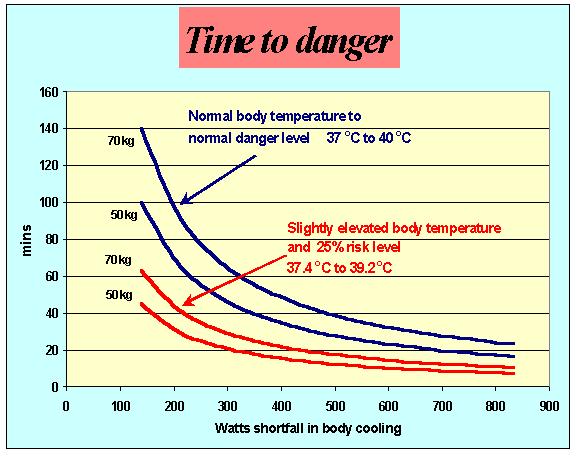
The Chart above shows the speed with which the body’s internal temperature can rise depending on how much it is deprived of necessary cooling. The chart shows two groups of lines. The upper lines in blue show the times for the body to reach the danger level of 40 oC for two different body weights. The lower lines in red show the time to danger with a slightly raised initial body temperature and the 25% risk level arising from a core body temperature of 39.2 oC.
Some statistics individuals and organisations need to be aware of :
- In the second world war the British Army saw one case of heat stroke per thousand soldiers. This was before heat illness was taken very seriously. Up to 1 in 50 of these heat stroke cases died.
- In [US] road races approximately the same rate of heat stroke is seen ie 1 per 1000 participants.
- In athletics events the American College of Sports Medicine has indicated that on very hot days up to half the participants may need treatment for heat illness of all types.
- UK expeditions monitored by the Royal Geographic Society experience a medical incident every 150 person days. In hot climates about 14% of these are heat related.
2) How quickly can the condition become fatal ?
Heat stroke can cause death very quickly if not treated adequately. This has to be put in perspective. Tropical diseases in less developed countries and for instance Meningitis in developed countries, can take several days to develop to a stage where the patient’s condition is life threatening, and then can be fatal in a few hours. Heatstroke can be fatal straight away within a few hours.
Because fatality is possible very quickly with heat stroke, it is possibly the deadliest of conditions which most people are likely to meet.
The danger is much greater if the illness happens where there is a long journey time back to civilisation.
3) How quickly can treatment bring the body to safe internal temperatures ?
The death rate is dependent upon the rate at which casualties are cooled. Whole body cooling in ice cold water can bring the body’s temperature down from 40 oC to 37oC in about 20-30 mins. According to Dr Lawrence E Armstrong’s book “Performing in Extreme Environments” this method has had no fatalities in 252 cases. Less efficient methods take 2 hours with fatality rates of 20% to 80% for older casualties. There are even more inadequate treatments such as loosening clothes and putting wet cloth on the forehead.
4) Speed of transport to good medical facilities
Heat stroke must be successfully treated in the field.
There is no time to evacuate.