is the danger?
Why is heat dangerous ?
Even a rise of 2 °C from the body’s normal temperature can have profound effects on the way the body’s internal chemistry works. With a couple more °C rise there is considerably more danger with potentially fatal consequences.
The body generates a lot of heat when exercising or undertaking physical work.
When at rest the general ticking over of the body produces 90-110 watts, about the energy output of a bright traditional electric light bulb, which gives out most of its engergy as heat when on.
When exercising energy production can increase 15-20 times, and about 80% of this is produced as heat, while the remaining 20% goes into actual movement.
Activity like walking up stairs rapidly produces internal heating of about 1 kilowatt, equivalent to a single bar electric fire. Very vigorous activity, usually short term bursts, can generate 1.4-1.8 kilowatts in highly trained athletes. This is the power of a small electric kettle.
Although the body has a lot more water in it than a kettle, the way the body works means it cannot tolerate an internal temperature of more than 40 °C which is 104 °F. This is only 3°C [ or 5.4 °F ] above the body’s normal temperature of 37 °C [ 98.6 °F ].
If there was no way of losing heat energy, then going up stairs quickly would increase the body’s temperature by about 1 °C every 5 minutes, and you would be up to this dangerous internal temperature after 15 minutes.
A prolonged period with the body temperature above 40 °C is often fatal.
There are variations to consider too.
Although the body temperature is normally taken as 37 oC it can vary. Studies have shown that the normal resting body temperature creeps up when in a hot environment and can be around 37.4 oC. Not much of a difference, but another factor is that when the body gets above 39.2 oC there is a 25% chance of heat illness, and so the safety margin can be reduced to 1.8 oC [ 3.2 oF ]. If your body is not well adjusted to handle the heat then it is very easy to tip into heat illness when working or exercising.
To understand why hot environemnts are dangerous for people from temperate climates, it is important to be aware of what the differences are in the way the body looses heat between temperate and hot surroundings.
Temperate climates
The day time temperature is typically up to 24 °C [ 75 °F ], and about 70% to 80% of the body’s heat is lost through radiation and convection. The remainder is lost through the evaporation of sweat on the skin.
Hot climates, and hot working environments
As the temperature rises the loss of body heat during exercise through radiation and convection falls to 10% to 15% at 32 °C [ 90 °F ].
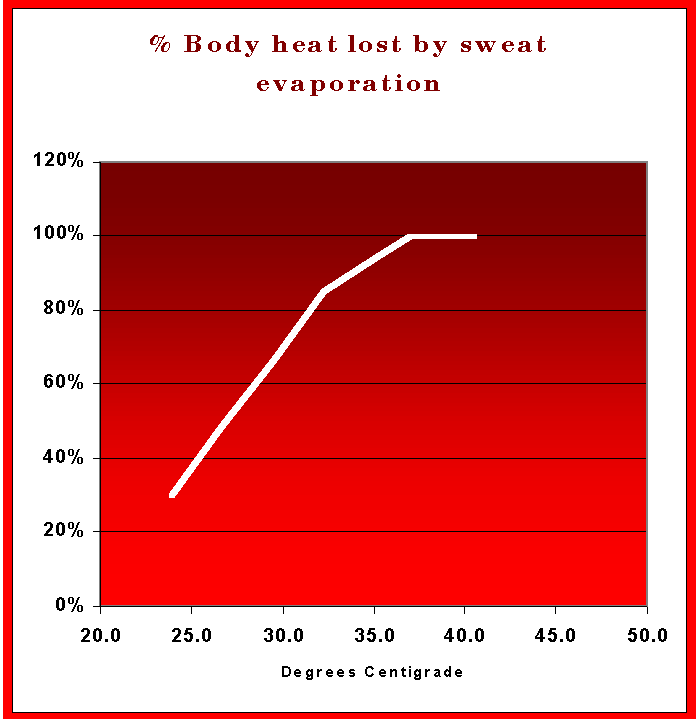
At 37 °C [ 98.6 °F ] heat loss by radiation and convection falls to zero because the surrounding temperature is the same as the body and these two processes are not possible when the surrounding environment and the body are at the same temperature.
At temperatures above 37 °C the environment’s temperature being greater than that of the body causes heat to enter the body, adding to the internal heat being generated by the body’s normal activities. Radiation and convection cause heat to pass from the hotter environment to the cooler body.
As the external temperature increases, a greater and greater proportion of the body’s internal heat has to be lost through sweat evaporation. Above 37 °C the body has to use evaporation to loose all its body heat, as well as any heat absorbed from the environment .
In hotter environments much more sweat is required to get rid of all the heat which is no longer removed by radiation and convection from the body. Because you will sweat much more than in temperate climates, you will loose water much more quickly and you must keep drinking to replace it, or you will dehydrate. Dehydration in turn reduces the amount you sweat making the situation more dangerous.
When people go from temperate climates to hot environments, it takes some time for the body to adapt in a number of ways . This process of adaption is acclimatisation.
If you undertake exercise at the same rate as you did in lower temperatures while the body is adjusting your body would start to heat up too quickly. If this exercise is quite vigorous your body could reach a dangerous temperature in quite a short time. If you do not stop and cool off heat stroke can follow.